Showing posts with label Gloucestershire. Show all posts

Saturday, 20 May 2017

Cold Aston, Gloucestershire


We don't often meet people at the churches on our travels, and when we do they're generally welcoming and either we exchange pleasantries or have a little chat about our shared interest in the building. As we stood drawing in the porch at Cold Aston, though, a long trail of tinies from the adjacent school trooped into the church and took their places in the pews. I shouldn't mind this, should I. It's an example of the church Actually Being Used. But I didn't like it. Now I can't say I know much about children, but I do know that I was once one of them. And when I was five I had a soft, receptive, gently forming brain. I seem to remember I liked filling it with dinosaurs and trips to the swings.

It's not that I don't think that children should get a education in Behaving Nicely to their Fellow Man. Of course a bit of moral guidance is the way to encourage a nice society where we all help each other and think about others. But I just thought it was very odd that they were shuffled into the church, as though talking about being helpful or kind or whatever it was, couldn't be done in an ordinary setting. As though by going in the church, God would be watching. The teacher (she was wearing a football strip, bizarrely) seemed to switch between that patronising slow sing-song voice some people use with small children, and then swooping on individuals to berate them for their fidgiting or previous misdemeanours. I thought the whole thing was rather creepy, it didn't sit well with me.

I don't know what I'm trying to say really. But it didn't seem quite right to be moulding such small children's minds using the building in that way. It wasn't the same as going there of a Sunday with one's parents to listen to the vicar.

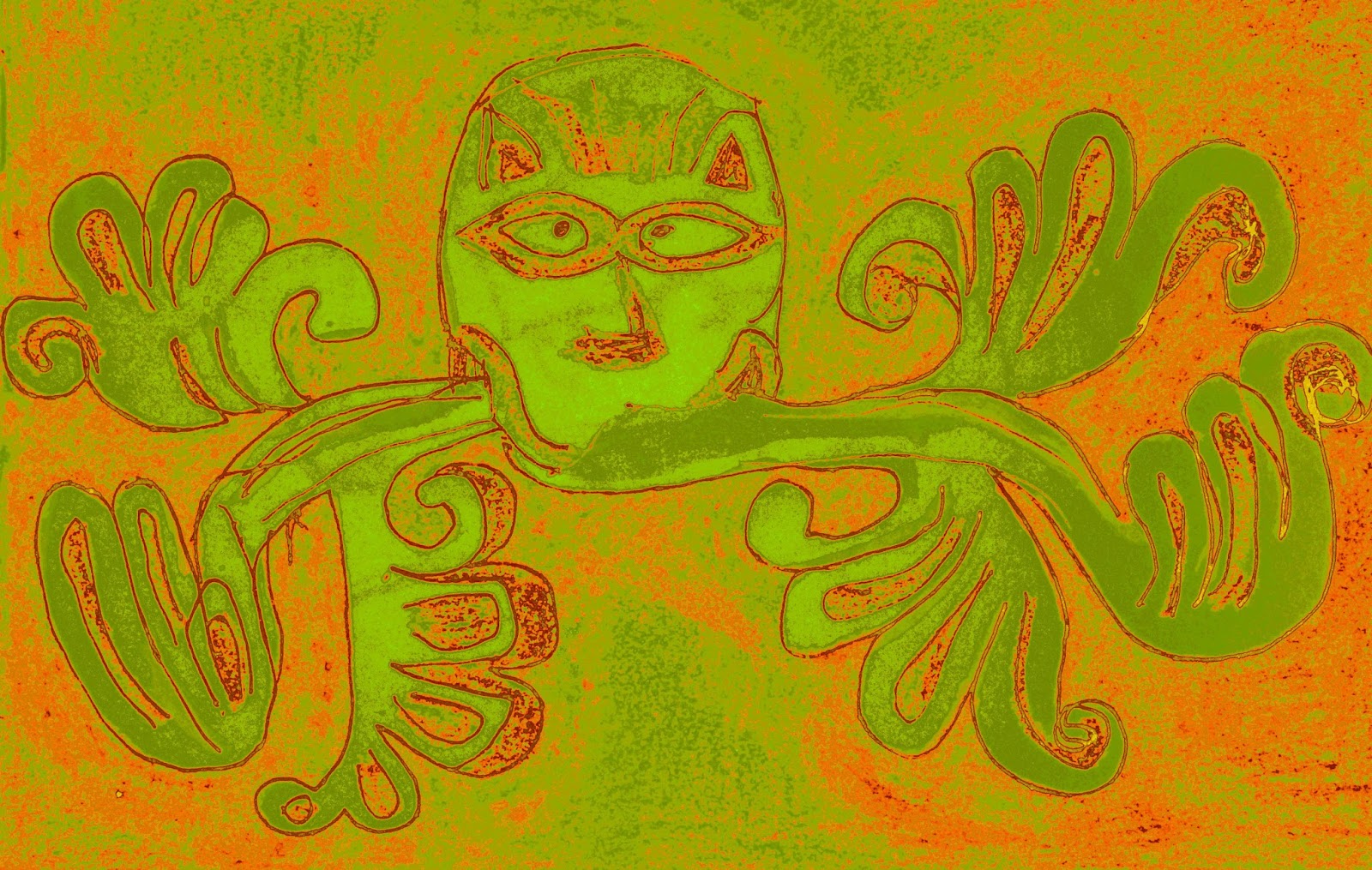
Anyway. There were some interesting bits of carving at Cold Aston. The tympanum was an all-over repetitive pattern (I admit photoshop has helped me with the above depiction) with some rather familiar style weaving foliage underneath. This was very well preserved and rather nice.

Also there seeemed to be a bit of knotwork in the porch - one assumes Anglo Saxon. You can see the collection of bits and pieces here on Britain Express. I always like to see a bit of Saxon knotwork, and because they're quite a challenge to draw, they're always especially satisfying to have a go at. Various descriptions on the internet mention "entwined serpents" but I fear this is overly optimistic. B and I have seen quite a few serpenty examples and this one wasn't doing it for us. But we both felt that there might be little clasped hands - as we independently came to this conclusion I set some store by it.

There was also a Maperton-esque little head, which B drew.

Windrush, Gloucestershire

Windrush is an excellently romantic name for a village (and the stream that runs through it). It seemed to be another well-heeled Cotswold spot. And maybe it's a good job that it's well-heeled, because some money has been recently poured into the renovation of the church - specifically, its amazing doorway. Because the door here is surrounded by not one, but two rounds of beakheads. It's a first for us. I can't think there can be many examples of the Double Beakhead in the country. So it's excellent to see it's being looked after.

The beakheads have just been cleaned. And they've been cleaned very thoroughly. In fact almost so thoroughly that they looked quite odd. But I guess they can now carry on for another thousand years. They're on the south side of the chuch, and have a small roof over them to protect them a little from the rain, but nothing major. Perhaps their south-facing aspect has been what's saved them for so long. It would be nice if they had a porch. But they're so interestingly animated that in a silly way I quite like that they can see out.

SSH Conservation carried out the work. You can see photos of the Before and After on their website. You can see how bright and stark the doorway is now - as it would have done when it was first carved, an interesting thought. The faces are a bit different from the beakheads we've seen before. B called them menacing, as I recall. They've certainly got quite intense expressions on their beaky faces. Their almond-shaped eyes remind me a bit of insects or aliens! The characters are quite varied. They don't all have beaks to cling onto the roll of the doorway. The drawing above shows two non-beaky ones.

A silly thing happened as I admired the doorway - I took a step backward and promptly fell up the steps that lead down to it. An unusual feature, in my defence. I just sat down on my arse and lay there, it wasn't dignified but it was quite funny. I hope it at least gave the beakheads something amusing and unusual to see.

Bibury, Gloucestershire


Saturday, 31 October 2015

Southrop, Gloucestershire


The main attraction at Southrop surely has to be its amazing Norman carved font, with its symbolic human figures, lettering, buildings and detailed patterns. Perhaps I was overwhelmed by it, but I gave it a go. You'll notice that for once I was sensible and focused in on the detail. Even so, it didn't take long to find out the detail was pretty detailed. It's got that characteristic that we both like to seek out... that is, patterns that are repetitive, but slightly dissimilar in each repetition. Even in the tiny extract above you can see differences on the right and left (it's not just my careless drawing).

But I wasn't a huge fan of the carvings of figures. Maybe I'm just not used to them, as they're unusual and B and I both like the Romanesque classic flora and fauna and geometric forms. But the thing I didn't really appreciate was the violence. The carvings are supposed to be the Virtues overcoming the Vices. But I'm not sure it's very virtuous to go stabbing or thrashing or trampling people. And I always say everyone needs a vice, I'm not against vices per se. So I found the carvings a bit unpleasant and so didn't feel that inspired to draw them.


So there I am in a church with one of the fanciest Romanesque fonts in the area, and I don't really like it. In fact I'm more drawn to the capitals in the porch. Of which this is one. And it's got zigzags, swirls (volutes), round bits going into square bits, and those boudoir trifle biscuits at the bottom. That's more like it.

There was a nice bit of beading on the chancel pillars as well, with saltire crosses and a wheaty band - really rather simple and kind of Anglo-Saxonesque.


The font at Southrop is quite uncharacteristic of the sculpture we've seen before. Maybe Norman times were indeed full of knights slashing at each other but that's not the image one gets from toothy dragons and swirling foliage. I wonder whether the creator of the Southrop font was working to a brief or whether it was a topic they felt strongly about and got Really Into. Nearby Stanton Fitzwarren (scene of a visit last year foiled by a locked door) has a very similar font, doubtless by the same hand.

I think B may have taken photos of each 'window' of the font. I feel as though I should go through each one and try to analyse what they show. But it seems a little too unpleasant for now.

We'd had an excellent bright autumnal day in the Cotswolds in the Van, and it seemed a fitting final odyssey for the year.

Coln St Aldwyns, Gloucestershire


Oh how I love a nice dragonny headstop, and the church at Coln St Aldwyns (whilst being a bit Victorian and bland for the Romanesque connoisseur) has two excellent ones, which are considerately sheltered in the porch.

It's got a dog-style nose reminiscent of the top quality examples at Elkstone, Leonard Stanley, or our recent trip to Somerset's more distant Dinder. Its teeth are excellently large and bitey, and there's some good runkling along the nose and around the cheek. The ears are quite small and cute but it's got an intense expression in that eye. There was something strangely bumpy between the ears. I wondered if was a devilish horn, but I think there was only one of them... it was a little bit odd as the rest was so clearly carved.

There was another similar animal on the right-hand side of the door, which B drew. But as usual I was becoming a drained wimp with all the concentration of drawing the one above. This can be disappointing when the carvings are so excellent :)

Quenington, Gloucestershire

It's been getting noticeably difficult to draw on our last few excursions, what with dingy weather and shortening days. So B and I thought we'd make a final trip for the year to a few further-afield, but bound-to-be-good sites. I'd scribbled some notes on a bit of paper and we leapt into the Van. It always feels like more of an expedition if you take the Van.

Having arrived at Quenington, anticipation was high but we consumed some snacks to raise blood sugar for the drawing ahead. Nevertheless I was still confused when we stood outside the amazing doorway - weren't there supposed to be beakheads? Our favourites the beakheads?  The door was amazing though - absolutely huge and with so much decoration it was as if someone had gone a bit mad and couldn't stop adding to it.


There was too much to draw and I felt overwhelmed. I was rather taken by this foliage-spewing animal (a green animal as opposed to a green man, you might say). There were also some borders of big flowery designs:


As we read the information booklet from inside the church, I realised that there were beakheads after all. But they were around the doorway on the other side of the church. OMG there are TWO DOORWAYS?! We walked round to be met by an equally elaborate and quite crazy sight. How can one church have so much Romanesque marvellousness? It was entirely overwhelming. I could only draw a little more. You could come back here every day for a year. 
The tympanums (tympani?) both had human figures on them. But when faced with so many creatures and excellent patterns, who needs Romanesque people? I think I know where my current interests lie (and this was confirmed later at Southrop).


Sunday, 2 August 2015

Kempley, Gloucestershire


Someone at the roadmap company chose to mark this. So I'm not sure it was really where we were aiming for, but as the brown roadsigns started appearing, I started following them. And after much windiness of road we ended up at St Mary's, Kempley. Our quarry was the lovely 'tree of life' tympanum pictured above. As the ancient structure of the porch obscured the view (see Nicholas Kaye's photo), we had to stand very close and crane our necks back (another of Mr Kaye's photos here shows what we were up against). I really believe that the design (as well as I could make out) was as wonky as above. So it's interesting to see the nearby unobscured tympanum at Dymock on the CRSBI website because it's so similar, but not wonky. I think I prefer the asymmetrical one really... it's one of those characteristic things the connoisseur of Norman carvings looks forward to :)

Inside the church was a rare treat - in fact, "one of the most outstandingly complete and well preserved sets of medieval wall paintings in England" according to its caretaker, English Heritage. Simon Jenkins goes even further: "the most complete set of Romanesque frescos in northern Europe".

Retrospectively it's interesting to see how the painting of the underside of the chancel arch echoes the carved detail we saw beneath the arch on our later visit to Marden.

Kempley also makes you wonder how colourful any number of these places were originally. Though it seems quite strange and crowded to the modern eye - like the Elgin / Parthenon marbles, we've become used to the stark minimalist look of the churches and sculptures being unpainted.

Perhaps I didn't appreciate the frescos as much as I should: a combination of turning up not particularly prepared, plus being surrounded by Other People - the latter being most unusual and strangely off-putting. You need a special sort of quiet to want to get your sketchbook out. But I'm glad other Romanesque fans were out in force that day (really).

Sunday, 3 August 2014

Leonard Stanley, Gloucestershire

St Swithin's church is huge and grand and impressive. There was a priory at Leonard Stanley and it's clear the church was part of it, you can almost imagine the monks. The church has got a huge central tower - something B and I are starting to recognise as an sign of ancientness. There was a lot of really interesting carving, including a couple of very detailed corbels. One of them showed Jesus having his feet washed by Mary Magdelen and her long hair. It was impossible to see properly because it was so high up, so it was impossible to draw and impossible to take a photo of. Which was a shame. You can get some idea from Eric Hardy's photo on Flickr.

Mr Hardy also has a good photo of the reclining figure on another high-up corbel. I don't know who the figure might represent but he looks pretty relaxed. John Harding seems to think that it's to do with the Nativity, because he thinks the Baby Jesus is on the side, looked over by a cow. But why would such an important part of the story relegated to the side of the pillar? I'm not convinced. Isn't that a hand on the pillar - is it a humanoid cow in a robe?? And if that is the infant Jesus, why is half the scene apparently missing? Does this mean it's all been moved or rebuilt round? It all seems quite weird. The Leonard Stanley website thinks it's fine, and the reclining figure is Mary. But that strikes me as quite peculiar, as such a scene seems unusually personal. And as I recall, Mary had to squeeze out Jesus in a stable, not somewhere with a posh bed. I'm such a cynic. But sometimes it pays not to believe everything you read.

I was most taken with the two animals in a carving more at eye height. It's said to be 'Adam and Eve as grotesques'. Again it's a bit of a strange concept. Why would you carve the first man and woman as weird animals? Admittedly there's some kind of fruit-swapping moment going on. In a tree, possibly. But animals eat and share fruit all the time. It doesn't mean they're doing it in some kind of metaphorical or allegorical fashion. So I'm not sure I go for the explanation. But I love the carving whatever it means or meant. Martin Davis has a clear photo on his 'Freeranger' blog.

strange Romanesque sculpture of Adam and Eve? in Leonard Stanley, Gloucestershire


What was truly rather curious and disappointing was that an amazing carved font was outside the front door, being used as a plant pot. It had a massive crack in it. It surely must be Norman. I mean it's a font that's about 800 years old! So bizarre to leave it outside, so casual, so dismissive of what it actually is. Colin Baxter has a rather charmingly tinted snap of it from 2010. You'll notice the cable design round the top, and the palmette leaves. I'm sure they both indicate its age. I think it's a shame the current churchgoers don't decide to take care of it and move it out of the snow and rain.

It was also surprising to me that there was zero information about the church in the church. It's clearly well used by the congregation, it seemed to have a happy lively atmosphere and was colourfully decorated. But don't 21st century Christians care much about the heritage of their churches, and communicating that to others? Surely they should. There was a booklet about the history of the war memorial (weirdly) but nothing about the amazing Norman carvings.

In addition to the amazing column capitals and the font there were bold and simple carved capitals (which anywhere else would have really drawn the eye), and outside the main door, two dragon heads kept watch. B and I instantly recognised the style as the same as the ones we'd seen and drawn at Elkstone. They were surely done by the same people, or closely copied. We wondered if there was a workshop somewhere churning out carvings which people could choose from! And it was interesting to see these familiar faces, after having seen the matching quadruplet animal corbels at Moreton Valence.


Norman dragon carving at Leonard Stanley

John Harding also has a photo of the scene high up over the door with the dragons - it seems to be a carving of three figures sitting and holding something between them, which is said to be a scroll, though that's not very obvious. His photo shows that there are two tiny animal heads as well - we certainly couldn't see this from where we stood. I think he must have had a ladder or a camera on a stick!


Images © Rhiannon 2014

Moreton Valence, Gloucestershire

St Stephen's church is between the River Severn and the very straight Roman A38, down a quiet little dead-end road. We had to walk round the back of the church to find the carvings - discovering the tympanum inside a very quaint half-timbered porch, along with some very ancient tombstones. This north side definitely felt forgotten. But it seemed to make more sense when we wandered towards a little bridge over some water - it was a rectangular moat. English Heritage's record says that this dates to 1253 when King Henry III gave ten Forest of Dean oaks to William de Valance to build a hall. Maybe that's why the grand side of the church faces that way. Or maybe it's the reverse, and that's why the moat is on the north side because it faced the pre-existing church entrance.

Whichever, we both liked the carving. It's not as bold as some, but neither was it as clearly detailed as others we've seen. It's not that clear whether the creature is a dragon or a wyvern - the lines were a bit vague. And poor St Michael didn't have much of a facial expression. But I did like the flag on his spear.

Some of the swirling shapes don't seem to quite make sense (the one under his sleeve, which is perhaps a wing), and the foliage on the right seems to be coming out of a plant pot (which I like). Our new Tympanum Bible (Keyser) calls the shapes on the left 'souls', but I'm not wholly convinced. They're certainly numinous but I thought they looked more like clouds or waves. Who knows.


St Michael and the dragon tympanuum, Moreton Valence, Gloucestershire

Outside on the north corners of the church were some really cute animal corbels. It was hard to say what sort of animal really - bears? pigs? They were clutching their little faces in a very sweet way.

Norman animal corbel at Moreton Valence church, Gloucestershire

 There were four carved pretty much the same. Which was interesting considering the carvings we saw next at Leonard Stanley.


Images © Rhiannon 2014

Sunday, 6 July 2014

Avening, Gloucestershire


One of the Romanesque capitals inside Holy Cross church, Avening. It rather reminded me of one of the ones at Knook.


This wraps round one of the capitals on extremely tall pillars at the entrance. The feather-like leaves reminded me of the ones on the Norman so-called 'Tree of Life' at Rodbourne. But the line down the middle of the branches is reminiscent of Anglo-Saxon carvings we've seen, and the funny little blobs also reminded me of the A-S carvings at that freaky place, Britford. So maybe that indicates it's quite an early example?


And this is the capital on the left side of the door. I don't know what's going on above or beneath the animal's head, it's very strange. Maybe I misinterpreted it and it's a tree behind? There's a photo on Churchcrawler's Flickr page which perhaps suggests so. The two-bodies-one-head is something I've seen at Lullington in Somerset, as you can see on this Flickr page. But my sister pointed out a very interesting thought - what if these are more Picasso style, and there aren't really two bodies, but two views of the same animal, which is why they're joined at the head at the corner of the pillar? It's not a thought I've had before and it's a good one.

You'll notice the old favourite of tail-tucked-under-the-leg :) The bodies are definitely animals but the head is really quite strange, more human.

There was much more of Romanesque excitement at Avening. And inside, even a very worn bit of presumably Anglo-Saxon interlace. But it was so worn that with such a wealth of other things to draw it got overlooked (for now).


These are the patterns on the other Norman capitals inside the church.


Images © Rhiannon 2014

Cherington, Gloucestershire

We ducked out of the rain into the porch at St Nicholas, Cherington. I didn't feel sure that the lions were properly old and Norman, mostly because they haven't got the 'tails under legs' theme. And they've got strange little heads. They look more like little cats than big lions. Which would be fair enough if you'd never seen a lion (it reminds me of a photo of an elephant and castle on Deborah Harvey's blog.  Maybe they're fine and genuinely Romanesque though. They were in a tympanum after all. And they're doing that affronted thing face-to-face. B was happy enough. Maybe this is an excuse to visit Many More Tympanums to compare.


There's a photo of the lions on Rex Harris's Flickr page. Wherever we go, he seems to have got there before us.

Since our visit I read on the British History website that there was another tympanum:
"A second more elaborate tympanum, said to have come from the south wall, is at Cherington Park."

Mmm more elaborate. But I can't find a picture of it on the internet (yet).  Wasn't it great when you could just stroll off with a tympanum and stick it on your own grand house. Cherington Park's just next door to the church. Perhaps I should have just gone and rang the bell. Maybe it was moved when Mr Baldwin repaired the church in 1815 and saw fit to carve his own name on the lintel below below the lions. Tch.

A slight Cherington update (8.8.14)

I noticed on British Listed Buildings that the other tympanum was still on Cherington Park in the 1980s, despite the building's 'partial demolishment' in the 1950s. So this is good news for tympanum fans. (All two of us.)

I've also found out what the tympanum depicts, thanks to my lovely InterLibraryLoan of Charles Keyser's 1927 book. He says: "On upper part a sundial with serpent above, a lion on left, and griffin on right. Below four courses of the fish scale ornament, and three rows of indented on the lintel." He also says 'Probably moved in 1816', so perhaps he had the same idea as me about it being appropriated when the church was repaired. It sounds as if it is an interesting design.


Images © Rhiannon 2014

Saturday, 3 May 2014

Elkstone, Gloucestershire

There's so much to see at Elkstone that I ended up feeling rather overwhelmed by it all. Too much choice! and in the end I hardly drew anything.
 
In the gloom beneath the tower there is a large broken slab with an interlace design. The blurb in the church called it 'pagan' which seems a bit imaginative (though I'm not sure what era it would be from). It was impressively solid. In any other church it'd take pride of place. But in the competitive environment of Elkstone, it ends up relegated to a dingy corner behind some chairs.
This striking dragon head (with very scary teeth) is on the left of the chancel arch. He has a nice doggy nose and beading up his snout.

 Images © Rhiannon 2014

Stratton, Gloucestershire


 Images © Rhiannon 2014

Daglingworth, Gloucestershire


 Images © Rhiannon 2014

Saturday, 26 April 2014

Somerford Keynes, Gloucestershire

All Saints church has an amazing Anglo-Saxon doorway. It's been opened up and tastefully glazed. It looks beautiful from inside and makes the space light and superb.
 
You can almost imagine stepping through it into another time.

From the outside you can see the long-short arrangement of stones which is characteristic of Anglo-Saxon architecture. Over the doorway is an arch with a simple twisted rope design. It's very striking the way the stones are so chunky and yet the gap is so narrow. It sort of fits the shape of a person. It was difficult to see inside. This rather added to the Portal-like effect.

 Images © Rhiannon 2014

Harnhill, Gloucestershire

This tympanum is over the door at St Michael and All Angels.


Maybe we're more likely to think that modern dragons have four legs. But all the ones my sister and I have come across seem to be the two legged, long-tailed variety. I'm guessing Welsh dragons and English dragons are actually different species. Here's a dragon getting abused by a sword-wielding St Michael (in his skirt). I say leave the poor creature alone. The carving is quite green with algae, but I don't think that detracts from its niceness.

 Images © Rhiannon 2014


Ampney St Mary, Gloucestershire

These strange creatures are at the isolated church of Ampney St Mary. There's a photo of them on Bethan's blog here.


  In fairness it was just about to hammer down with rain, but I didn't position this so well on the page. They're some of my favourite creatures yet. One might be a lion with a tidy bottom and super elegant back legs. Another a griffin? They've both got the tail-under-leg thing going on. But what are those two creatures underneath! They've got kind of Cheshire Cat style faces. But strange maggoty legless bodies.


 Images © Rhiannon 2014 

South Cerney, Gloucestershire


The Norman door at All Hallows has it all. You could draw it for weeks. Rex Harris's photo illustrates the beaky creatures, the zig zags, some neat flowers, and some amazingly intricate patterns in the innermost arch. I thought the latter even smacked of something interlacey and Anglo-Saxon... I need to draw them to explore the patterns (have to go back).


The door jambs have an interesting beaded motif, rather like stone hinges. They form little shelves.


I love drawing vegetationy scrolls. They're so easily overlooked. But if you draw them, you really See them. And I enjoy that, I feel like I'm properly interacting with what the carvers intended, nearly a thousand years ago.


 Images © Rhiannon 2014