Showing posts with label tympanum. Show all posts

Tuesday, 25 July 2017

Flax Bourton, North Somerset

There is a rule of Sculpture Seeking, viz. that if you come to a T junction in a village, you are more likely to take the direction away from the church you're looking for, regardless of how much logic and deliberation you apply. So it was when we finally rolled into Flax Bourton (that we had already been lost was entirely down to my overconfidence in navigating roads out of Bristol).

So when we arrived at the church on this hot day I was already a bit flustered and irritable. The church is right on the main road - probably the closest to a road that we've ever seen. It's got a wall built in front of the door so you can't walk out into the juggernauts (and previously the horses and carriages). Someone has paid for a rather nice glass door to seal the porch off from the noise and pollution. Seeing this, I foolishly thought that it might mean a warm welcome.

No, it didn't. The door was locked. I could lean on the glass and squint under my spread fingers to try and look in without reflections. I could even see the carving. But the door was locked.

I just want to ask, WHY? If you don't want people to steal all the presumed gold candlesticks in the church, why not lock them away like all the other churches we visit? But even if you lock the church itself, why can't people even get into the porch? Is Flax Bourton really the centre of an international crime ring focused on church porches? No-one can even get into the porch to read the noticeboard. I know I'm a heathen and you might only want to let in good members of the congregation that come to services on a Sunday - fair enough. But mightn't Christians want to pop in at other times?

I was disappointed.

We went to the stone circles at Stanton Drew instead. They were fully accessible.

You can see photos on Deborah Harvey's blog. She gets a bit carried away and calls them Saxon - I think as they match so many things we've seen, they're almost certainly Norman. She shows there are more lovely carvings inside the church - not least a cat and a winged legless dragon (these are also misbilled as Saxon). The latter is the first we'd have seen in my recollection. I think it's called an Amphiptere. It would have been an exciting moment. Here's a picture of one to make up for all that disappointment.

From Fictitious and Symbolic Creatures in Art by J Vineycomb.

Saturday, 20 May 2017

Cold Aston, Gloucestershire


We don't often meet people at the churches on our travels, and when we do they're generally welcoming and either we exchange pleasantries or have a little chat about our shared interest in the building. As we stood drawing in the porch at Cold Aston, though, a long trail of tinies from the adjacent school trooped into the church and took their places in the pews. I shouldn't mind this, should I. It's an example of the church Actually Being Used. But I didn't like it. Now I can't say I know much about children, but I do know that I was once one of them. And when I was five I had a soft, receptive, gently forming brain. I seem to remember I liked filling it with dinosaurs and trips to the swings.

It's not that I don't think that children should get a education in Behaving Nicely to their Fellow Man. Of course a bit of moral guidance is the way to encourage a nice society where we all help each other and think about others. But I just thought it was very odd that they were shuffled into the church, as though talking about being helpful or kind or whatever it was, couldn't be done in an ordinary setting. As though by going in the church, God would be watching. The teacher (she was wearing a football strip, bizarrely) seemed to switch between that patronising slow sing-song voice some people use with small children, and then swooping on individuals to berate them for their fidgiting or previous misdemeanours. I thought the whole thing was rather creepy, it didn't sit well with me.

I don't know what I'm trying to say really. But it didn't seem quite right to be moulding such small children's minds using the building in that way. It wasn't the same as going there of a Sunday with one's parents to listen to the vicar.

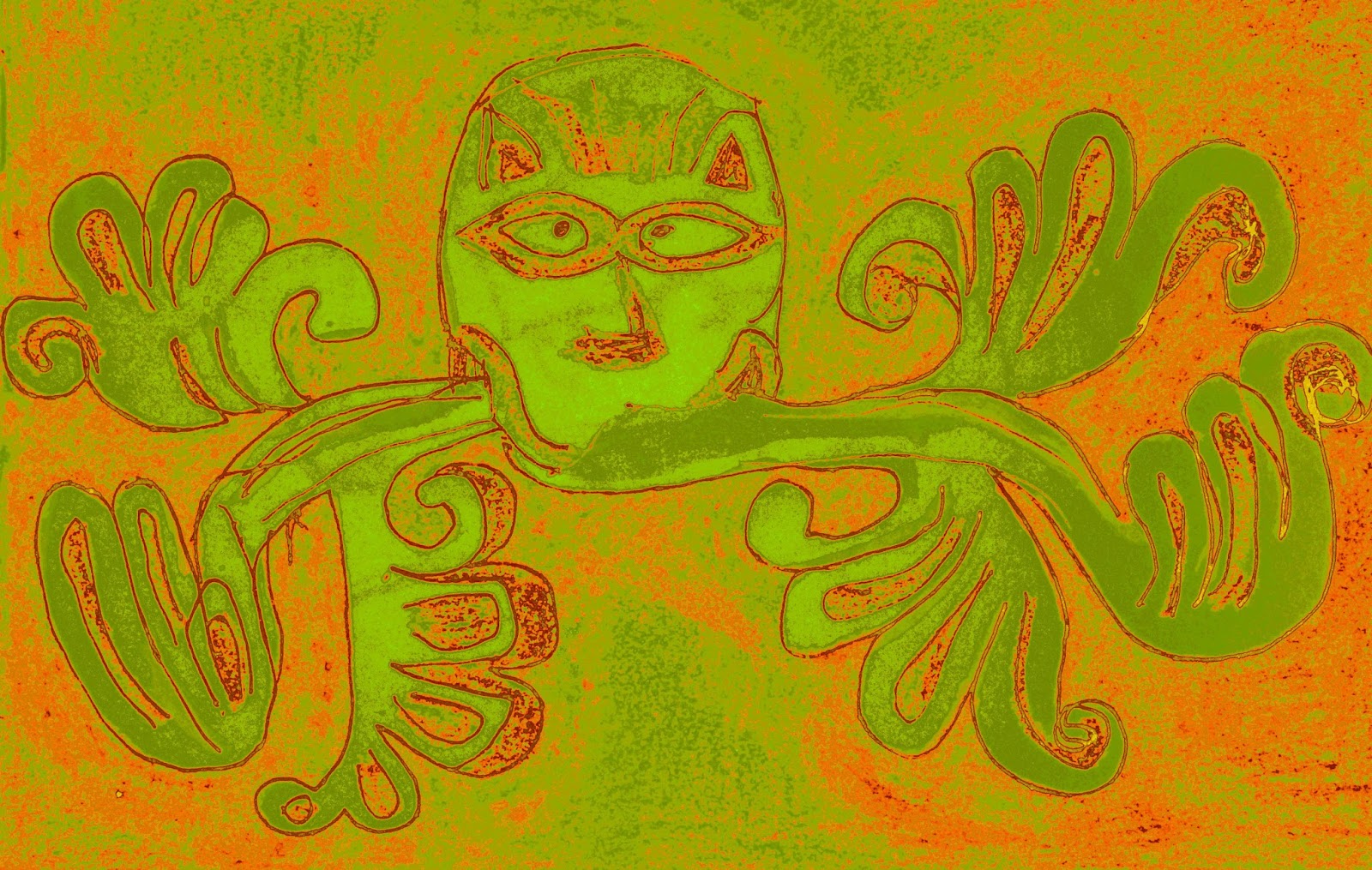
Anyway. There were some interesting bits of carving at Cold Aston. The tympanum was an all-over repetitive pattern (I admit photoshop has helped me with the above depiction) with some rather familiar style weaving foliage underneath. This was very well preserved and rather nice.

Also there seeemed to be a bit of knotwork in the porch - one assumes Anglo Saxon. You can see the collection of bits and pieces here on Britain Express. I always like to see a bit of Saxon knotwork, and because they're quite a challenge to draw, they're always especially satisfying to have a go at. Various descriptions on the internet mention "entwined serpents" but I fear this is overly optimistic. B and I have seen quite a few serpenty examples and this one wasn't doing it for us. But we both felt that there might be little clasped hands - as we independently came to this conclusion I set some store by it.

There was also a Maperton-esque little head, which B drew.

Wednesday, 28 September 2016

Damerham, Hampshire

It's about time I typed up our visit to Damerham, part of our visit to the New Forest. It seems so long ago that I can hardly remember its setting. Perhaps this is proof that memories are created by going over things in your mind. Perhaps writing this blog is good for my brain.

The church looks very ancient with its squat low tower.

CC image by Clive Perrin
I don't remember the church being open. But our main quarry was the tympanum over the door. This is not the best rendering but it was our last spot of the day...


So there we have a long-bodied horse (with rather nice decorative mane and reins) trampling on a person trying to protect themselves with a shield (a person apparently wearing some knightly headgear and a rather fancy belt). The rider isn't so clearly delineated (at least from the angle we were drawing at) and his short sword is probably something to do with the replaced? bit of stone at the top of the tympanum. But what's that in the right hand corner? B and I stared at this for ages but didn't come to any conclusions. It looked faintly birdlike, with long legs and a wing, but I doubt that's correct. Perhaps it's something knight-related that a Norman knight would recognise. But to the modern eye it's rather bemusing. It looks a bit like a bag with arrows sticking out of it. But not enough to be that. There's a big photo on the CRSBI website.


Saturday, 26 December 2015

Pipe Aston, Herefordshire

B and I have been to see the carvings at Pipe Aston before. But that was in the days before the Dawn of her Enthusiasm for the Romanesque. So it was interesting to see the look on her face when she realised what she's seen then, but not Seen. The carvings here are pretty bloody impressive, some of the best.

She immediately started making comparisons between the style and designs here and the marvellous font we saw at Stottesdon. These are top notch Herefordshire school carvings. And yet this is apparently a tiny church in a hamlet in sight of the back end of beyond.

Here's a large bird apparently pecking a smaller bird while a doggish creature spews what I take to be foliage at them. It's part of the carving on the tympanum. There was so much to draw... but it was frustratingly cold and windy so this was the only element I attempted outside. 


Here's the tympanum as captured by John Salmon.
There's our favourite, the Lamb of God, in the centre, with his little leg bent round cutely to support his pole with the cross. The cutely bent horizontal leg seems to be a diagnostic Romanesque feature.  He's also got some kind of radiating nimbus thing going on, but without any circular halo. Flanking him is the winged ox and leggy eagle of (I imagine) the evangelists. Not to mention more animals with tucked-under tails, plenty of patterns, a bit of planty swirlyness. The stones supporting the tympanum are serpenty and planty. Even the chevrons over the top are obviously excellent - they're single stones smoothed into a 3-d shape in a most satisfying fashion. The tympanum is in three parts but they seem different colours, almost as though it's not been broken accidentally but were always separate. Though that would seem a bit odd, given the strange angle. But who knows.

Inside, there's more Norman goodness. It's even said that the planty paintings on the walls are original, which seems quite crazy but perhaps it's true. What took my eye though was the sculptural goodness of the curious tapering small font. It's carved with two animals - one is a wormy tailed wyvern with two little front legs and wings. He's biting the tucked-under tail of the animal in front of him. I originally assumed that one would be a dragon but he's apparently four legs and a tail, and perhaps more of a lion. He's spewing out foliage and does not look best pleased at his tail being nipped. The circular scene fitted nicely in my new long sketchbook:


From the NLS's amazing map website


This is the 6 inch 1884 map of the village. Sometimes I wonder if a little bit more prior research could be a good idea... we had no idea this Motte was here, so close to the church. It must surely explain something - maybe this spot wasn't so remote as it might appear. It's called 'Aston Tump' and the Scheduled Monument Record  says it was constructed in the 1130s - a timber castle. There's a stream which flows down the hill here, forms a little moat round the motte and then pops out by the church - we stood and watched the water so doubtless we'd have noticed the 6m high motte if only we'd been expecting it! Never mind. The CRSBI page for the church suggests the carvings are also from the 1130s. So that's rather interesting. I am treating myself to a copy of Thurlby's book on the Herefordshire school which they cite.

Saturday, 31 October 2015

Quenington, Gloucestershire

It's been getting noticeably difficult to draw on our last few excursions, what with dingy weather and shortening days. So B and I thought we'd make a final trip for the year to a few further-afield, but bound-to-be-good sites. I'd scribbled some notes on a bit of paper and we leapt into the Van. It always feels like more of an expedition if you take the Van.

Having arrived at Quenington, anticipation was high but we consumed some snacks to raise blood sugar for the drawing ahead. Nevertheless I was still confused when we stood outside the amazing doorway - weren't there supposed to be beakheads? Our favourites the beakheads?  The door was amazing though - absolutely huge and with so much decoration it was as if someone had gone a bit mad and couldn't stop adding to it.


There was too much to draw and I felt overwhelmed. I was rather taken by this foliage-spewing animal (a green animal as opposed to a green man, you might say). There were also some borders of big flowery designs:


As we read the information booklet from inside the church, I realised that there were beakheads after all. But they were around the doorway on the other side of the church. OMG there are TWO DOORWAYS?! We walked round to be met by an equally elaborate and quite crazy sight. How can one church have so much Romanesque marvellousness? It was entirely overwhelming. I could only draw a little more. You could come back here every day for a year. 
The tympanums (tympani?) both had human figures on them. But when faced with so many creatures and excellent patterns, who needs Romanesque people? I think I know where my current interests lie (and this was confirmed later at Southrop).


Saturday, 5 September 2015

Great Durnford, Wiltshire

In terms of Whoops Per Minute, Great Durnford turned out to be approaching the top of the league table. It has not one, but two Norman doorways with patterned tympanums. And inside, a stupendous font. And then - look at those weird carvings near the door jamb! And then! a big chancel arch with two crazy winged creatures. And on top of that, some swirly painting. And some absurdly ancient pews. It was all a bit much. There was much squealing. I also squealed a bit at the end when I saw a huge spider in the porch. But B assured me it was dead (as she quickly hurried me away).


This is the amazing font. The amount of work that must have been put into it is huge. But Mr Pevsner lets us down. This is his description: "Circular, Norman; short, primitive interlaced arches; band of volutes over." Mr Pevsner, really?? Is that the best you could have done? You didn't want to mention the little faces created by the design of the mini columns? The sheer number of arches? The fantastic swirliness of the Danish pastryesque designs around the top (which even put me in mind of the swirliest font in the world, the one at Deerhurst.. yet to be visited). Oh Mr Pevsner how tired you must have been not to have been more enthusiastic.


Here's the font in its natural habitat. We removed the cover. It was the most inappropriate and foul thing imaginable. If you've got a strong stomach you can see it in this photo by Rex Harris.  It's absurd, it looks like a silly hat. Yeah it's probably Jacobean. But that doesn't make it tasteful.


By the south door were these slightly crazy sea-anemone-like carvings. They reminded me of something similar at Lullington in Somerset. Those are over the doorway (and at its foot), which you can probably see better in this photo by Phajus. But they're not quite the same. I like the way these are different sizes from each other and a bit randomly spaced. The unevenness is just so appealing, so human.


The design looks properly folded over / pinched in (think Danish pastry again). To create something so organic out of a solid bit of stone is surely quite a feat. I don't know why they're down only one side of the door. I like them a lot. All this talk of food made me wonder if, since there are seven, if they were the seven loaves in the 'feeding of the 5000' (correction - there were 5 for the 5000 and 7 for the 4000. Who knew). But then where are the fishes? There are no fishes. So it's not that. Who'd pass over the chance to carve some fish. But maybe it doesn't need to be anything. Maybe trying to find Explanations For Everything is highly overrated (more of this in my Leominster ramblings).

Meanwhile either side of the chancel arch, perching on the roll at the bottom of each capital, are two creatures. One is very dovelike, but the one on the left isn't so easy to classify. It's got big (feathery?) wings just like its partner, and likewise three little toes on each foot cling to the capital, but it's not a bird. It sports a big cheesey grin, a fat tummy, and sticking-out ears. It might be tempting to see something naughty and impish in it, to contrast with the good dove opposite. But it doesn't look very naughty. Its eyes are outlined in a very nice Norman way: John Vigar has a photo here. He calls it an owl. I'm not sure about that though, they're not renowned for their smiles.


There's plenty more to be drawn from the photos B kindly took at Durnford. So I will do that soon.

Berwick St James, Wiltshire


There are always nice little surprises when we're out and about tracking our quarry. This morning's was the pack of alpacas opposite the church. They were very nonchalant though and refused to come over.

We couldn't get into the church, but luckily the Thing Of Interest was the north door, protected by an open porch. The arch is 3D chevrons, with a stripey green and white outer border. The tympanum is made of green and white blocks, and underneath there's a lintel with a carved diamond design (a bit asymmetrical, but that's what you expect and want from a Norman lintel).

The green stone is really very green. I've been wondering what it might be and where it might be from. Maybe it's greenstone, really green greenstone?! There's a quarry today that's not a million miles away at Hurdcott. We've not seen this stone used in doorways elsewhere as far as I can remember, so perhaps it's a rather local design. Mr Pevsner mentions its use at Stapleford (the adjacent village), but I can't find any photos on the internet, and I can't fully remember our visit (it was after our creepy experience at Britford). Perhaps we will have to return.

Saturday, 15 August 2015

Milborne Port, Somerset

B and I have resumed our adventures, but owing to endless hold-ups with internet access at my house, it makes me wonder whether I'll be able to record everything before it disappears from my head. We often have conversations that run -

- Ooh look at that, that's rather like the column at.. now where was it.. you know, that church with the doorway, was it somewhere near X??
- You mean the one with the trees?
- No no no, but yes it did have trees, but the one where we walked up that path. Did it begin with D??

These lovely "affronted animals" (meaning facing each other, rather than being offended) were on the tympanum at St John's church in Milborne Port. They're pretty cute (you can see the original on this link). The surrounding design reminded me very much of the one around Samson and the lion at Highworth.

The church is big and has remnants of Anglo-Saxon-ness - a massive central tower with much fiddly leaf-inspired carvings on the capitals. Unfortunately they were very high up and we couldn't see them properly. They weren't the bold simple style you might expect. We needed a ladder really.

There was also a Norman font, but it seemed to have been hacked about mercilessly. It had arches on the sides but they looked strange - I thought it must originally have been a square font made octagonal by the cutting off of the corners. The base was offensive to the eye. I'm getting far too fussy these days but that's what happens when you expose yourself to all the best examples.

Sunday, 2 August 2015

Kempley, Gloucestershire


Someone at the roadmap company chose to mark this. So I'm not sure it was really where we were aiming for, but as the brown roadsigns started appearing, I started following them. And after much windiness of road we ended up at St Mary's, Kempley. Our quarry was the lovely 'tree of life' tympanum pictured above. As the ancient structure of the porch obscured the view (see Nicholas Kaye's photo), we had to stand very close and crane our necks back (another of Mr Kaye's photos here shows what we were up against). I really believe that the design (as well as I could make out) was as wonky as above. So it's interesting to see the nearby unobscured tympanum at Dymock on the CRSBI website because it's so similar, but not wonky. I think I prefer the asymmetrical one really... it's one of those characteristic things the connoisseur of Norman carvings looks forward to :)

Inside the church was a rare treat - in fact, "one of the most outstandingly complete and well preserved sets of medieval wall paintings in England" according to its caretaker, English Heritage. Simon Jenkins goes even further: "the most complete set of Romanesque frescos in northern Europe".

Retrospectively it's interesting to see how the painting of the underside of the chancel arch echoes the carved detail we saw beneath the arch on our later visit to Marden.

Kempley also makes you wonder how colourful any number of these places were originally. Though it seems quite strange and crowded to the modern eye - like the Elgin / Parthenon marbles, we've become used to the stark minimalist look of the churches and sculptures being unpainted.

Perhaps I didn't appreciate the frescos as much as I should: a combination of turning up not particularly prepared, plus being surrounded by Other People - the latter being most unusual and strangely off-putting. You need a special sort of quiet to want to get your sketchbook out. But I'm glad other Romanesque fans were out in force that day (really).

Saturday, 6 September 2014

Bromyard, Herefordshire

En route elsewhere, B and I stopped in Bromyard to check out the Romanesque carving at St Peter's church. I'd been super-organised beforehand and looked at the church's website - it said encouragingly that it was usually open all day. But it's so rare that we actually bump into anybody that we were a bit taken aback to find the car park full and the sound of jolly Christian singing in the air.

I'd missed the page that said the churchgoers were becoming a Missional Community. Which is lovely for them of course. And (quite seriously) I am very glad that someone's looking after this amazing building. And even (despite my cynicism) probably, that they're using it for its original purpose. I guess. If I sound mean it's only because the mindset of a Missional Community could not be further from my own. It's not that I disagree with the idea of local community, or being charitable, moral, kind, decent and helpful to others, not killing people, refraining from coveting your neighbour's ass or any of those other sensible Christian tenets. It's the other bits about believing in Jesus as the Son of God and a virgin, who died for your sins in a horrible way on a cross, the bits about angels and devils and Noah's ark and the bible being the inspired and direct word of God, oh and the resurrection. No amount of missional communitying is going to get me to go for any of that.


Here's St Peter and his keys. You can see a photo by Matthew Wells on Flickr.


So we wandered around the outside of the building admiring the lovely carvings, which in some way seemed even nicer for their slightly softened eroded look. At the front door another wandering touristy pair walked past us and into the church. We could hear them being offered alcoholic drinks. It struck me as a bit odd. I suppose Jesus liked a drink, after all he did turn water into wine. But it smacked of a bribe. Or maybe 'what do heathens like drinking? I know, booze. That'll lure them in.' Or a way to relax the unwary so they could be talked to persuasively. I dunno, it was just a bit odd.


We sooo wanted to see the font, it looks smashing. You can see the lovely carvings on the CRSBI website (one side is swirly, the other side an alleged tree of life).

But I felt a bit like a vampire unable to cross the threshold. The Pimms-clutching pair emerged from the church almost immediately, looking vaguely bemused. We decided not to go in.


Images copyright Rhiannon 2014.

Monday, 25 August 2014

Highworth, Wiltshire


Inside St Michael's, in the centre of Highworth, we found another of one of our favourite quarries, the Tympanum With Animal. Unfortunately this animal is being rather mistreated. It's said to be a picture of Samson and the Lion. This may well be the case. He's straddling it and has a hand round each jaw (a brave thing to be doing with a lion). The lion has the characteristic 'tail through leg' pose that's so familiar from many other places.

I had a look at the bit in the bible that talks about Samson and the lion (being a heathen, it wasn't familiar). "..behold, a young lion roared against him. And the Spirit of the Lord came mightily upon him, and he rent him as he would have rent a kid, and he had nothing in his hand: but he told not his father or his mother what he had done."

It's a bit mean isn't it. He gets surprised by a lion and rips it apart with nothing but his bare hands? And is too ashamed to tell his parents? That's the implication. Along with the fact that GOD had some hand in it. God involved in needless animal cruelty. Then it turns out the lion is just some weird plot device for an riddle (as part of a story containing a whole lot more violence). Next time he's passing, he notices that bees have made a nest in the lion's innards. So he uses this wholly unlikely situation to say "Out of the eater came forth meat, and out of the strong came forth sweetness". 

I can't be bothered to go into the biblical story (he gets cross and jealous and kills loads of people). Let us focus on the pleasant association, namely that the phrase is used on the front of Lyle's Golden Syrup tins. 


Image from Wikipedia

It's still utterly freaky though. And I doubt bees have ever nested in a lion. And golden syrup isn't made by bees by the way.

Back to the tympanum, you can see a picture on Britain Express. Where you will notice that somebody with no aesthetic sensibilities decided to carve a long explanation under the stone. If ever there were a moment to ask 'why oh why'... what a strange decision. As though their explanation was as interesting to look at, and as though it might matter in a thousand years. It's quite odd.

Images © Rhiannon 2014

Kencot, Oxfordshire

This is the excellent Norman tympanum over the doorway at St George's in Kencot. You don't expect to come across an astrological symbol on a church. I don't really understand what it's doing there. But then so many of the symbols seem quite obscure. I like Arthur Collins' 1914 Symbolism of animals and birds represented in English church architecture. But even he doesn't make any particularly convincing suggestion. He does say that Virgil had centaurs at the gates of hell. But to be honest they were probably on the side of the baddies, not there to put arrows down the devil's mouth, as the carving below suggests. And an archer is mentioned in Revelation 6:1-2. But he was sitting on a white horse, rather that being half man half horse. So I still have no idea. But I like the carving anyway and I liked the style of the lettering (and we haven't often seen writing at all).


I was quite pleased with this effort. In fact I sent it off with some others to be printed on postcards. I did notice 'Sagitarius' wasn't spelt right but I thought it was ok because that's How It Was. I'd stood there and copied the style of the writing really carefully.

Actually that's How It Wasn't. I just didn't notice there was another T between the centaur's head and the bow. My sister enjoyed pointing it out to me. This is a bit of a shame.

Images © Rhiannon 2014

Sunday, 3 August 2014

Moreton Valence, Gloucestershire

St Stephen's church is between the River Severn and the very straight Roman A38, down a quiet little dead-end road. We had to walk round the back of the church to find the carvings - discovering the tympanum inside a very quaint half-timbered porch, along with some very ancient tombstones. This north side definitely felt forgotten. But it seemed to make more sense when we wandered towards a little bridge over some water - it was a rectangular moat. English Heritage's record says that this dates to 1253 when King Henry III gave ten Forest of Dean oaks to William de Valance to build a hall. Maybe that's why the grand side of the church faces that way. Or maybe it's the reverse, and that's why the moat is on the north side because it faced the pre-existing church entrance.

Whichever, we both liked the carving. It's not as bold as some, but neither was it as clearly detailed as others we've seen. It's not that clear whether the creature is a dragon or a wyvern - the lines were a bit vague. And poor St Michael didn't have much of a facial expression. But I did like the flag on his spear.

Some of the swirling shapes don't seem to quite make sense (the one under his sleeve, which is perhaps a wing), and the foliage on the right seems to be coming out of a plant pot (which I like). Our new Tympanum Bible (Keyser) calls the shapes on the left 'souls', but I'm not wholly convinced. They're certainly numinous but I thought they looked more like clouds or waves. Who knows.


St Michael and the dragon tympanuum, Moreton Valence, Gloucestershire

Outside on the north corners of the church were some really cute animal corbels. It was hard to say what sort of animal really - bears? pigs? They were clutching their little faces in a very sweet way.

Norman animal corbel at Moreton Valence church, Gloucestershire

 There were four carved pretty much the same. Which was interesting considering the carvings we saw next at Leonard Stanley.


Images © Rhiannon 2014

Sunday, 13 July 2014

Stottesdon, Shropshire

B and I visited Stottesdon in mid-May. I (inadvertently) took a maze of tiny roads to get to the village. But even without a daft route I think it'd have an air of being a bit remote.

We've seen some pretty weird stuff in our travels but Stottesdon's lintel is very much up there with the weirdest. Finding it is an interesting matter in itself. I'd assume that the door it's over used to be a main entrance. It's at the west end of the church, under the tower. Today you have to enter from the south, and to get to the lintel you have to squeeze in the dark through a little doorway behind the organ. It would have been more impressive to come straight into the church by striding under the lintel - it'd have been quite a entrance. But the addition of the organ has made the west entrance an extremely dingy room that feels like a forgotten cupboard. Maybe I would moan if they turned it into a fluorescently lit tourist attraction. At the moment it's like stepping back in time, its setting gives it atmosphere, albeit not the original effect. But the 2 watt bulb (I'm guessing) didn't provide quite enough light to appreciate the carvings or take decent photos. And they are pretty amazing. They are pretty weird and pretty amazing.


There's a picture on Secret Shropshire that shows the fuller picture. You can see saltire crosses in the tympanum and also an enigmatic head at the top of the arch.


It was too dark to draw and it felt like a funny space to be loitering in, but I do wish I'd made some sketches at the time as it's very difficult to know if what I've drawn from my photos is strictly accurate. The photo above gives the impression that the carvings were whitewashed at some point?

But you can certainly comment on the basic design - it has two creatures which are upside down, and one which is the right way up. And even if the lintel is now the wrong way up, that's still one animal that's upside down! And what do the creatures represent? They're all quadrupeds at least. And one's got the 'tail tucked through its leg' thing going on. The upright one is sort of catlike. I think it's been suggested it's a lion. I wonder if it's got those weird long claws going on that we saw at Stratton. Or am I just misinterpreting an artefact of the photo? The creature with the tail-tucked-under has got quite a human face. And the final creature on the left - I found its head hard to make out. But the two upside down do have chunky long necks. That rather reminded me of creatures at Ramsbury. And what are those griddy bits next to them? All is very enigmatic and strange. I love that such a thing exists.

The other truly amazing thing at Stottesdon is the font. It is also fantastically ill-lit, as though the local people don't appreciate what they've got compared to practically every other church in the country! B and I opened the doors and turned on the lights to try and get a decent view so we could draw. It was a shame that as we were leaving, a woman bearing the church flowers arrived, and seemed more interested in our heinous crime of mistakenly turning on one of the outside lights on, than enthusing about the font. Maybe we looked dodgy (Strangers in Stottesdon) or maybe she was just very conscious of global warming. I'm very glad the church was left open though, so we could come in and see these marvellous things. Next time we'll bring flashlights. This is something of the designs on the font:


Images © Rhiannon 2014

Sunday, 6 July 2014

Cherington, Gloucestershire

We ducked out of the rain into the porch at St Nicholas, Cherington. I didn't feel sure that the lions were properly old and Norman, mostly because they haven't got the 'tails under legs' theme. And they've got strange little heads. They look more like little cats than big lions. Which would be fair enough if you'd never seen a lion (it reminds me of a photo of an elephant and castle on Deborah Harvey's blog.  Maybe they're fine and genuinely Romanesque though. They were in a tympanum after all. And they're doing that affronted thing face-to-face. B was happy enough. Maybe this is an excuse to visit Many More Tympanums to compare.


There's a photo of the lions on Rex Harris's Flickr page. Wherever we go, he seems to have got there before us.

Since our visit I read on the British History website that there was another tympanum:
"A second more elaborate tympanum, said to have come from the south wall, is at Cherington Park."

Mmm more elaborate. But I can't find a picture of it on the internet (yet).  Wasn't it great when you could just stroll off with a tympanum and stick it on your own grand house. Cherington Park's just next door to the church. Perhaps I should have just gone and rang the bell. Maybe it was moved when Mr Baldwin repaired the church in 1815 and saw fit to carve his own name on the lintel below below the lions. Tch.

A slight Cherington update (8.8.14)

I noticed on British Listed Buildings that the other tympanum was still on Cherington Park in the 1980s, despite the building's 'partial demolishment' in the 1950s. So this is good news for tympanum fans. (All two of us.)

I've also found out what the tympanum depicts, thanks to my lovely InterLibraryLoan of Charles Keyser's 1927 book. He says: "On upper part a sundial with serpent above, a lion on left, and griffin on right. Below four courses of the fish scale ornament, and three rows of indented on the lintel." He also says 'Probably moved in 1816', so perhaps he had the same idea as me about it being appropriated when the church was repaired. It sounds as if it is an interesting design.


Images © Rhiannon 2014

Tuesday, 17 June 2014

Dragons and Wyverns

It cannot be said that I'm totally wasting my time dashing all over the place, because I am actually learning a thing or two. For example, here we have my previously visited tympanum from Harnhill.


I've been reading John Vinycomb's 'Fictitious and Symbolic Creatures in Art', which you can download from Project Gutenberg. And so my previous confusion about our reptilian friend's lack of back legs is explained - he's not a dragon, he's a wyvern. Wyverns only have two legs and a nice tapering tail. There's even something called a lindworm which doesn't have any legs at all, but it can have optional wings, which probably makes up for the limblessness a bit.

I had childishly found it quite amusing that St Michael appeared to be wearing one of my dreadful school uniform skirts, unflatteringly flared and knee length. But, it turns out this is also totally deliberate. It suggests Michael is an Archangel. I think it's a bit of a management position if you're an angel.

Here's the relevant bit from the bible. It's from Revelation, which is a particularly Imaginative book if I recall correctly.
And there was war in heaven: Michael and his angels fought against the dragon; and the dragon fought and his angels, and prevailed not; neither was their place found any more in heaven. And the great dragon was cast out, that old serpent, called the Devil, and Satan, which deceiveth the whole world: he was cast out into the earth, and his angels were cast out with him.

So in this case, 'dragon' has rather negative connotations, it represents evil and bad behaviour, and various other saints can be found poking or standing on the creatures - St Margaret, St Andrew, St Sylvester - and St George of course.

But when you're British, you know it's not all black and white like this. Dragons have their positive connotations too. It's interesting to look at how dragons were viewed in the era when the tympanum was carved. Check out the wyverns on the Bayeux tapestry - they're right by the bit you may be familiar with, where Harold has got an arrow in the eye. There's a wider image here in which you can see the red wyvern being held up, and a lighter one being trampled. These excellent (perhaps hollow) banners were those of the Saxon army. So the Saxons obviously viewed dragons positively. Perhaps when I've seen dragonlike creatures on carvings like that at Colerne, it shows that they weren't all evil and naughty at all.

Dragon banner - Harold Rex interfectus est

Of course, the dragon is famous today for being on the Welsh flag. And this connection with the Celts can be proved to go back to 800 AD, since an allegorical tale of red and white dragons can be found in the Historia Brittanum (look at section 42 ). The dragons represent the native peoples and the Saxon incomers. Of course, it's possible (nay, likely) that dragons were important symbolically before this too.

To add to confusion, the Normans seem to have seen themselves as dragons too - there is a 12th century poem by Stephen of Rouen called Draco Normannicus.

And much later on, Henry VIIth, the first Tudor king, had a dragon as one of his emblems, because he was trying to convince everyone he was the right man for the job, ruling over both England and Wales. He claimed uninterrupted descent from the Princes of Britain - people (or legendary figures) like King Arthur and Cadwallader.

So in short, everyone likes to have the dragon as their symbol. And that is because dragons are excellent, and not just symbols of evil and badness. Anyone who has been brought up on Ivor the Engine and little Idris must agree.


saint and wyvern image © Rhiannon 2014

Saturday, 26 April 2014

Harnhill, Gloucestershire

This tympanum is over the door at St Michael and All Angels.


Maybe we're more likely to think that modern dragons have four legs. But all the ones my sister and I have come across seem to be the two legged, long-tailed variety. I'm guessing Welsh dragons and English dragons are actually different species. Here's a dragon getting abused by a sword-wielding St Michael (in his skirt). I say leave the poor creature alone. The carving is quite green with algae, but I don't think that detracts from its niceness.

 Images © Rhiannon 2014


Ampney St Mary, Gloucestershire

These strange creatures are at the isolated church of Ampney St Mary. There's a photo of them on Bethan's blog here.


  In fairness it was just about to hammer down with rain, but I didn't position this so well on the page. They're some of my favourite creatures yet. One might be a lion with a tidy bottom and super elegant back legs. Another a griffin? They've both got the tail-under-leg thing going on. But what are those two creatures underneath! They've got kind of Cheshire Cat style faces. But strange maggoty legless bodies.


 Images © Rhiannon 2014